
Exploring Machine-Learned Potentials for Transition-Metal Oxides at FM&NT 2026 in Riga
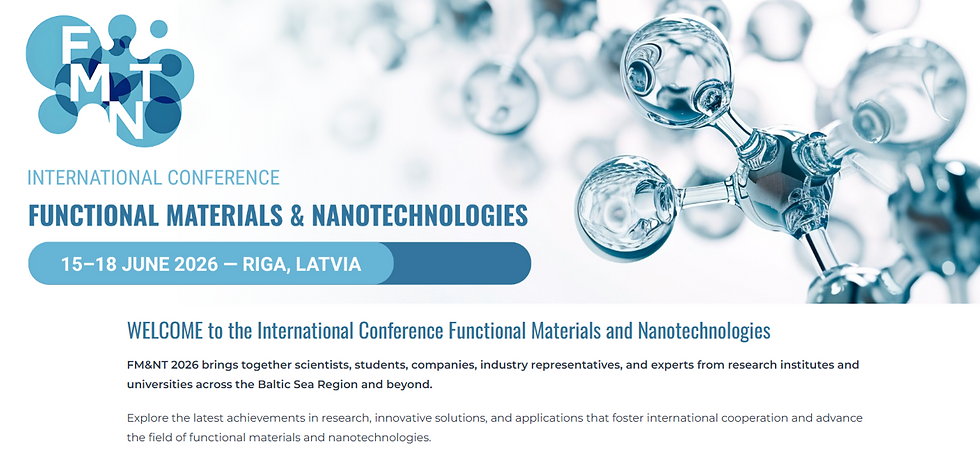
The International Conference on Functional Materials and Nanotechnologies (FM&NT 2026) will take place in Riga, Latvia, from June 15 to 18. This event gathers scientists, students, industry experts, and companies from across the Baltic Sea Region and beyond. They come together to share the latest research, innovative solutions, and applications in the field of functional materials and nanotechnologies. Among the notable speakers is Dr. Volker Eyert, who will present his work on machine-learned potentials for transition-metal oxides and offer training on the MedeA Software Environment.
Dr. Volker Eyert’s Presentation on Machine-Learned Potentials

On June 17, early afternoon, Dr. Eyert will deliver a talk titled "Machine-Learned Potentials for Transition-Metal Oxides." Transition-metal oxides are a class of materials with diverse and valuable properties, including magnetism, superconductivity, and catalytic activity. Understanding and predicting their behavior is crucial for developing new technologies in energy, electronics, and photonics.
Machine learning offers a powerful approach to model these complex materials more efficiently than traditional methods. By training algorithms on large datasets, researchers can create potentials that predict atomic interactions with high accuracy and reduced computational cost. Dr. Eyert’s talk will explore how these machine-learned potentials improve simulations and accelerate the discovery of new materials.
Training on the MedeA Environment
On the afternoon of June 18, Dr. Eyert will conduct a training session on the MedeA Software Environment. MedeA is a comprehensive platform used for materials modeling and simulation. It integrates various computational tools that help researchers design and analyze materials at the atomic level.
The training will cover practical aspects of using MedeA, including setting up simulations, analyzing results, and applying machine learning techniques. This session is valuable for scientists and students who want to enhance their skills in computational materials science and leverage advanced software for their research projects.
Key Topics at FM&NT 2026
FM&NT 2026 covers a wide range of topics that reflect the current trends and challenges in functional materials and nanotechnologies. These include:
Materials for Energy
Research on batteries, supercapacitors, hydrogen technologies, and nuclear power materials aims to improve energy storage and conversion.
Materials for Photonics
Innovations in light emission, detection, transformation, and quantum photonics support the development of faster and more efficient optical devices.
Ferroelectrics and Functional Materials
Studies focus on inorganic, organic, hybrid, and low-dimensional materials, including Van der Waals and topological ferroelectrics, which have applications in sensors and memory devices.
Microfluidics and Biomedical Technologies
Advances in organ-on-chip systems, lab-on-a-chip devices, biosensors, and micro-nano robotics contribute to healthcare and diagnostics.
Theoretical Modeling of Functional Materials and Devices
This area emphasizes predicting next-generation materials and their properties, often using artificial intelligence to guide experiments.
Technologies and Devices
Topics include nanotechnologies, sensors, thin films, coatings, fiber optics, and lasers, which are essential for modern electronics and communication.
Large-Scale Research Infrastructures, Science Policy, and Collaboration
Discussions on synchrotrons, neutron sources, and international collaboration highlight the importance of shared resources and policies in advancing materials research.
Why Attend FM&NT 2026?
FM&NT 2026 offers a unique opportunity to connect with experts and peers working on cutting-edge materials science. Attendees can:
Learn about the latest research and technological advances.
Participate in workshops and training sessions like the MedeA Environment training.
Network with scientists, industry representatives, and students from various disciplines.
Explore potential collaborations and partnerships in the Baltic Sea Region and beyond.
For those interested in discussing machine-learned potentials or other topics with Dr. Volker Eyert, it is recommended to arrange meetings in advance during the conference.
Final Thoughts
The FM&NT 2026 conference in Riga promises to be a hub of knowledge and innovation in functional materials and nanotechnologies. Dr. Volker Eyert’s contributions on machine-learned potentials for transition-metal oxides and his training on MedeA software will provide valuable insights and practical skills for researchers in this dynamic field.
If you plan to attend FM&NT 2026, consider engaging with Dr. Eyert’s sessions to deepen your understanding of computational materials science and explore how machine learning can transform materials research. For further information or to schedule a discussion with Dr. Eyert, please reach out ahead of the event.


Comments