
What's New in MedeA 3.13 - Atomic Insights at Scale
Updated: Jul 7

Materials Design announces MedeA 3.13, the latest release of its comprehensive materials simulation environment, delivering significant advances across model building, simulation, and analysis. This release brings atomic insights at scale — empowering researchers to tackle larger, more complex systems with greater speed and confidence.
A major addition is the new MedeA ML Property module, enabling rapid property prediction through machine-learned potentials for large-scale systems beyond the reach of conventional DFT calculations. There are major enhancements to structural builders with improved validation and visualization, advanced analysis tools for comprehensive materials characterization, and a new export feature for improved compatibility with the OVITO visualization platform.
The highly anticipated update to VASP 6.6.0 offers a new and very accurate NMR chemical shift computation for solids within the so-called ZORA approximation. The MedeA VASP interface now features access to new solvation models for studying solvated systems and much enhanced visualization of the electronic structure of solids, with new bandstructure projections and interactive Brillouin zone rendering. The enhancements to bandstructure visualization benefit MedeA Phonon users as well. Also highly relevant to VASP users: full UI support and access to additional transition state search methods via the TSS module.
At the continuum end of the multiscale offering, this release continues the rapid evolution of the powerful MedeA PhaseField module, which now allows the modeling of nucleation, fracture, boundary elementary reactions, phenomena relevant to Li-ion batteries, and much more.
Key Features of MedeA 3.13
ML Property Module (NEW): Groundbreaking new module to direct prediction of atomic-scale properties for large-scale systems beyond the reach of conventional DFT calculations using a machine learned approach
VASP 6.6.0 Integration: New binaries with more accurate NMR chemical shift computations, enhanced optical spectra and projection data handling, and improved band structure visualization with interactive Brillouin zone rendering
Phasefield Module: Enhanced capabilities for modeling nucleation, fracture, boundary elementary reactions, and other phenomena
Transition State Search (TSS): Full access to established VASP and VTST methods with comprehensive documentation and support
Enhanced Builders: Improved amorphous structure generation, random perturbation display, input validation for slabs, and surface generation enhancements
Advanced Analysis Tools: Enhanced band structure and phonon dispersion rendering, improved geometric pair subset analysis, extended projection data handling with element filtering and aggregation capabilities
OVITO Export: New export feature for improved compatibility with OVITO visualization platform
Extended Engine Support: LAMMPS ReaxFF preprocessing enhancements and GIBBS 9.8.3 binary with updated scripts
Clive Freeman, CEO of Materials Design comments:
This release marks a major step forward in accelerating process optimization and discovery through advanced simulation and machine learning. At the heart of this release is the new AI-based ML Property module, which allows researchers to quickly predict properties such as charges, core-level energies, electric field gradients, and partial electronic densities of state, even for systems beyond the scope of traditional first-principles methods. Alongside the innovative ML Property module, this release introduces enhanced structural builders, expanded transition state search capabilities, and powerful new analysis tools. Together, these features enable users to explore increasingly complex materials problems with greater confidence, speed, and precision. As Richard Hamming noted, the purpose of computing is insight. This principle guides our development. The MedeA productivity environment helps you efficiently extract the insights needed to advance your research.
Overview of MedeA 3.13
An overview of updates in this MedeA release is provided below.
Builders and Editors
Amorphous Materials Builder
Enhancement of amorphous structure generation capabilities
Random Perturbation Builder
Enhancement of bond display for significantly perturbed structures
Microstructure Builder
Enhancement of input validation for slabs with distance verification
Extended parallelization for efficient building of structures with large numbers of atoms (mllions of atoms)
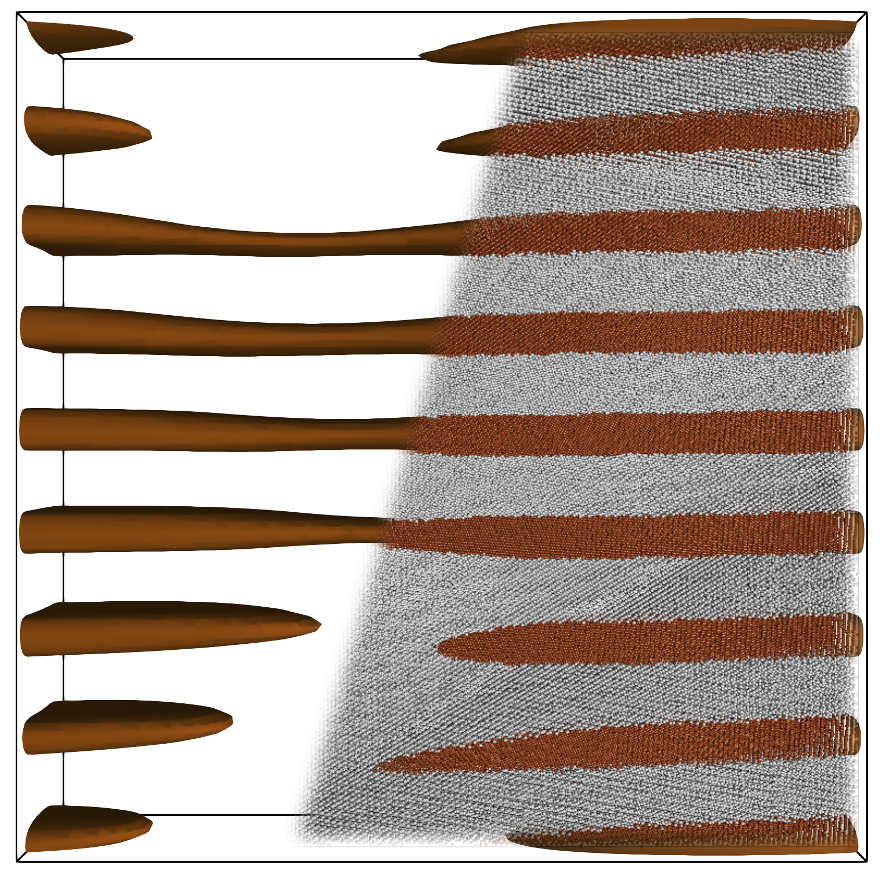
Support for importing of phase field simulations results and experimental data for realistic atomic microstructure building
Surface Builder
Enhancement of surface generation and rendering
Subset Manager GUI
Enhancement of graphical interface for subset management
Engines
![Scatter plot titled Hg showing orange circles and blue triangles trending downward with dashed and solid lines; x-axis δexp [ppm].](https://static.wixstatic.com/media/541861_f044009d67534b0baedeb669984331c0~mv2.png/v1/fill/w_603,h_862,al_c,q_90,enc_avif,quality_auto/541861_f044009d67534b0baedeb669984331c0~mv2.png)
VASP
New VASP 6.6.0 binaries
New VASPsol++ linear and local implicit solvation model as an alternative to the original VASPsol model
New VASPsol++ nonlinear and nonlocal implicit electrolyte model as a further option
New CP-VASP for DFT calculations at constant electrode potential, grand canonical ensemble for electron dynamics
Added spin-orbit coupled or scalar-relativistic zeroth-order regular approximation (ZORA) for NMR chemical shielding computations
Added nucleus-independent chemical shielding (NICS) tensor calculation at off-nucleus positions
Added output of NMR current response to an external magnetic field
Added support for NMR data in MAGRES format for post-processing
LAMMPS
Enhancement of ReaxFF preprocessing for wildcard handling
Improved handling of angles, torsions, and hydrogen bonds
Improvement in custom forcefield loading
GIBBS
New GIBBS 9.8.3 binaries
PhaseField
Fracture support
GUI support for nucleation
Classical nucleation theory (nucleation rates)
Integrators for bulk and grain boundary elementary reactions (trapping and catalysis)
Dendrite support for two-phase problems for solidification and lithium-battery applications
VTS compositional eigenstrain via CLI
Partial assembly to reduce memory for 3D problems
Major speedup for elastic problems (Voigt tensor change)
Electrochemistry support via CLI
Piezoelectric coupling via CLI
Property Modules
ML Property (NEW)
Direct property prediction for large-scale systems beyond the reach of conventional DFT using a machine learned approach
Rapid calculation of atomic-scale properties:
Partial electronic charges
Core level energies
Electric field gradients
Partial electronic density of states (DOS)
Efficient batch processing of structure ensembles
Systematic property screening capabilities
Phonon
Improvement in symmetry-related guidance and messaging
UNCLE
Added random number generator seed input for improved reproducibility of results

Transition State Search (TSS)
Full access to well-established native VASP and VTST transition state search implementations already used by many VASP standalone and expert MedeA users
Complete integration of these methods in MedeA's processing, post-processing and energy profile analysis
Increased convenience for running on high-performance computing centers
All transition state search techniques are fully documented and supported on Linux and Windows
Additional Solid-State Nudged Elastic Band method offered by VTST

Analysis and Post-Processing
Structural Analysis
Enhancement of geometric analysis of pair subset distributions
Electronic Band Structure
Enhancements to band structure plots
Added an interactive 1st. Brillouin zone visualization indicating the k-point path for improved clarity and understanding of the band structure
Improvements to style and formatting of band structure plots for increased customizability of the presentation
Improvements in band structure handling of projection data
Support for l,m-projections on atoms
Automated summation of multiple sites of the same element
Customizable summation of projection data for aggregation
Filtering of projection data by site/atom, element, and custom summation
Addition of capability to normalize projection data to atomic contributions

Figure 124 Band structure plot containing l,m-projections with interactive 1st. Brillouin zone visualization Phonon Dispersion
Enhancement of phonon dispersion rendering
Added an interactive 1st. Brillouin zone visualization indicating the k-point path for improved clarity and understanding of the phonon dispersion
Improvements to style and formatting of phonon dispersion plots for increased customizability of the presentation

PhaseField Visualization
Addition of dedicated 2D OpenGL viewer infrastructure for improvement in PhaseField visualization
Forcefields
ReaxFF wildcard handling for angles, torsion, and hydrogen bond terms has been enhanced.
General Improvements
New OVITO export feature for improvement in compatibility with OVITO visualization. Exporting to OVITO is now available for all MedeA single structures, as well as trajectories and structure lists.
Extension of plot generation capabilities for ACE machine learning potentials
Added support for SVG export to the various plotting tools
Improved export of MedeA plots to CSV and text files
[2] T. Speelman et al., J.Chem. Phys. 145, 104115 (2025)


Comments