
VASP and Supercomputers – a Marriage made in Heaven


Looking back at many years supporting research-driven industries with scientific software solutions, I see few trends that have transformed the world of scientific research more than the shift from real-world laboratories to “in silico” exploration and simulation. With the advent of AI, this trend is likely to further accelerate.
I was fortunate to do my PhD in Cambridge/UK at a time when the foundations for “ab initio” density-functional-theory (DFT) based materials simulations were being laid. 30 years later, successors of the software codes developed during that time, especially the Vienna Ab initio Simulation Package (VASP), have become the true underpinnings for this shift to “in silico” research in Materials Science. VASP is thereby at the heart of two megatrends in scientific computing: “digital twins” and “machine learning”.
Besides accurate and predictive software, an essential enabler for the efficient digital exploration of materials properties has been the increasing availability of high-performance computing resources (HPCs). In this blog post, I’d therefore like to celebrate the longstanding marriage between VASP and Supercomputers by offering some background and statistics.
VASP is by far the most widely used density functional theory (DFT) code for atomistic simulations and electronic structure predictions worldwide. As a result of the value and insights that it provides, VASP is broadly deployed across national supercomputing facilities. In many centers, it is the most widely used application.
It is likely that 10-20% of the workloads running on national supercomputing centers in the US and Europe are VASP-centric calculations. For example, a 2023 NERSC talk notes that VASP alone accounts for at least ~20% of the NERSC workload. Similarly, as of 2022, VASP use on the UK’s primary National Supercomputing Service Archer2 accounted for 41.8% of overall usage. VASP is also among the most popular codes at many other European and American supercomputing centers, especially those dedicated to physical sciences and materials research.
The key reason for this trend is the pivotal role that VASP plays in providing accurate atomistic simulations for materials research and industrial applications. Google scholar suggests that the number of publications referencing VASP (currently about 20,000 annually) far exceeds the number of publications referencing any other individual DFT code, and this publication rate continues to grow at a rapid pace.
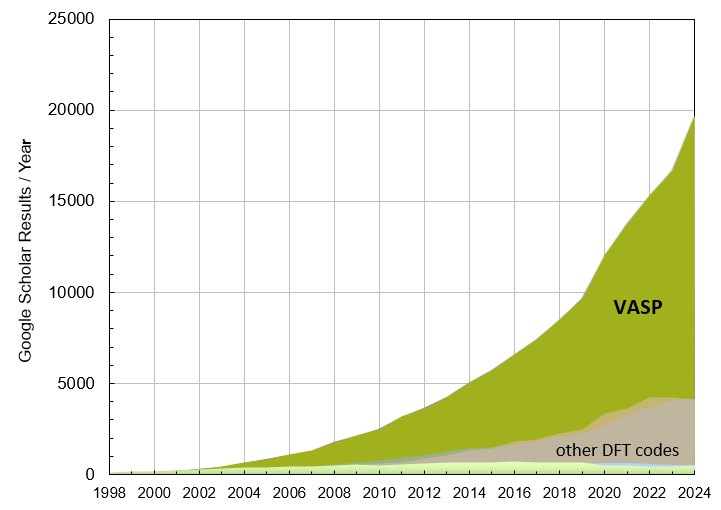
VASP is also the de facto standard for generating training sets for machine learning – be it for the purpose of machine-learned interatomic force-fields or to train models that can be used to optimize materials properties computed with VASP. For example, total-energy-based and other properties in the popular and widely-used Materials Project database are derived from VASP calculations, and these results are extensively used to train machine-learned potentials. As of 2025, a Google scholar search suggests that of the 20,000+ publications referencing VASP, close to 20% also contain the terms “machine” and “learning”.
In recent years, many supercomputing facilities worldwide have greatly expanded capacity for graphical processing unit (GPU) computing to support scientific and engineering AI applications. Owing to its unique and efficient architecture, VASP has long supported GPU acceleration. VASP runs efficiently on NVIDIA GPU partitions in many HPC centers. Examples are NERSC’s Perlmutter system, LBNL’s Lawrencium system, and CHPC at University of Utah. VASP support for non-NVIDIA GPU architectures is under development.
As HPC architectures evolve toward increasingly heterogeneous CPU-GPU environments, users and host HPC centers alike face additional challenges in deploying, benchmarking, and maintaining efficient VASP workflows across systems. Productive VASP usage on HPC infrastructure places increasing emphasis on automation, reproducibility, and traceability of results, and requires careful workflow design, consistent parameter management, robust job submission strategies, and systematic post-processing. For many organizations today, the central question is no longer whether to use VASP, but how to use it productively and reproducibly.
Materials Design’s MedeA is the only commercial solution to fully integrate VASP with interactive model building, job management, workflow and analysis capabilities, and it seamlessly integrates with many other atomistic modeling tools. It increases productivity and scientific accuracy by enabling users to focus on scientific insight and workflow design, rather than scripting, infrastructure, and workflow maintenance.
In summary: VASP is highly optimized for massively parallel, multi-node CPU and GPU environments. It is a critical workhorse for many of the scientific projects that benefit from national and international supercomputing facilities. VASP is an essential tool in the study of a vast array of applications in areas as diverse as battery technology, photovoltaics, semiconductor manufacturing, catalyst development, magnetic materials, polymers and coatings, surface and interface science, defect engineering, and even materials for nuclear fusion. As a result, VASP is a de facto standard for density functional theory (DFT) simulations in materials science, solid-state physics, and computational chemistry at supercomputing facilities.
It is an honor to work with so many fellow scientists using VASP. If you are interested in exploring the benefits and use of VASP in a specific HPC facility – standalone or in conjunction with Materials Design’s MedeA environment – please contact us. Materials Design and I can support a heavenly marriage between VASP and YOUR favorite supercomputer through all aspects of your projects – scientifically, logistically, and technologically.


Comments